
Solar 4G Cameras: Your Off-Grid Security Solution for Remote Islands
Island Surveillance with No Power or Wi-Fi? The SDL500 Solar + 4G is Your Off-Grid Security Solution
Securing remote locations like islands, coastal properties, or marinas presents a unique and frustrating challenge. You need robust surveillance, but you’re faced with a stark reality: no power grid and no wired internet. For years, this meant compromising on security, relying on infrequent physical patrols, or abandoning the idea altogether. As an engineer with over a decade of experience designing security solutions for these exact environments, I’ve seen countless projects stall due to these infrastructure gaps. Traditional security systems simply are not an option.
This is where off-grid technology becomes essential. The solution lies in a system that generates its own power and communicates wirelessly over long distances. A purpose-built solar 4G security camera is no longer a niche product; it is the definitive answer for reliable, independent surveillance. It addresses the core pain points of cost, complexity, and unreliability that plague attempts to secure remote assets.
The Engineering Behind True Off-Grid Autonomy
A truly effective off-grid camera is more than just a camera with a solar panel attached. It’s an integrated ecosystem designed for survival and performance in isolated environments. The core components must work in perfect harmony to deliver continuous operation, regardless of weather or location. At UBOXCAM, we focus our design on three critical pillars.
First is power sufficiency. This involves a high-conversion monocrystalline solar panel paired with a large-capacity lithium-ion battery pack. Crucially, a sophisticated Battery Management System (BMS) is non-negotiable. The BMS is the unsung hero, protecting the battery from overcharging, over-discharging, and extreme temperatures. Without a quality BMS, battery life can be cut by more than half, leading to system failure when you need it most.
Second is uninterrupted connectivity. While Wi-Fi is suitable for urban homes, it’s useless on a remote island. Our systems integrate a 4G LTE module that connects directly to cellular networks. This provides a stable, high-speed data link for live video streaming and instant alerts, transforming any location with a cell signal into a monitored zone. This is a fundamental difference between consumer-grade gadgets and professional wireless outdoor security cameras.
Finally, durability and low power consumption are paramount. The camera’s hardware and software must be optimized to sip power in standby mode and activate instantly upon detecting motion. The enclosure must be at least IP66 rated to withstand salt spray, dust, and heavy rain, ensuring the delicate electronics inside remain protected.
Introducing the UBOX CAM SDL500: Engineered for the Edge
Based on these principles, our team developed the SDL500 Solar 4G PTZ Camera. It is the culmination of years of field testing and feedback from partners operating in the most demanding locations. The SDL500 isn’t just a product; it’s a complete, deployable off-grid security node.
This camera integrates a high-efficiency solar panel, a robust battery with our advanced BMS, and a global 4G LTE module into a single, easy-to-install unit. With features like 360° PTZ control, Smart Dual-Light for color night vision, and AI-powered human detection, it provides comprehensive coverage without a single wire for power or data.
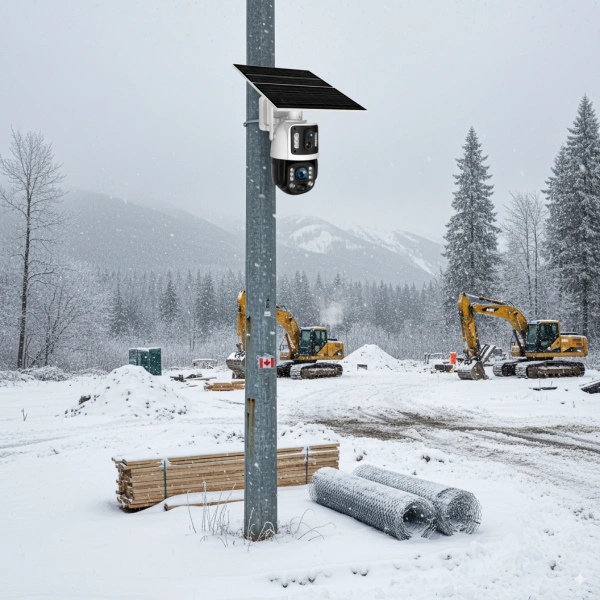
For distributors, installers, and B2B clients, the SDL500 translates technical features into direct business value: faster deployment, lower installation costs, and a premium, reliable solution for a growing market segment that competitors using traditional systems cannot serve.
Comparative Analysis: SDL500 vs. Alternative Systems
When presenting a solution to a client, a clear comparison is crucial. It highlights the value proposition and justifies the investment. Here is how the SDL500 stacks up against other common security approaches for remote sites.
| Feature | UBOXCAM SDL500 (Solar + 4G) | Traditional Wired System | Basic Consumer Solar Camera |
|---|---|---|---|
| Deployment Cost | Moderate initial cost; zero infrastructure cost. | Extremely high due to trenching for power and data cables. | Low initial cost. |
| Installation Time | Hours. Mount, insert SIM card, and power on. | Weeks or months, requires permits and heavy machinery. | Minutes, but lacks professional features. |
| Reliability in Remote Areas | Excellent. Designed for 3-5 days of autonomy without sun. | High, but vulnerable to power outages and cable cuts. | Poor. Small batteries and inefficient panels fail in low light. |
| Connectivity | 4G LTE Cellular. Operates anywhere with a cell signal. | Wired Ethernet. Not feasible in off-grid locations. | Wi-Fi only. Range limited to ~100ft from a router. |
| Scalability | Highly scalable. Add cameras as needed without new wiring. | Very difficult and expensive to scale. | Not designed for multi-camera professional systems. |
Case Study: Securing a Private Island Resort
- Problem: The owner of a private island resort in the Bahamas was experiencing issues with unauthorized boats docking at night and petty theft from beachside cabanas. With no existing power or internet infrastructure beyond the main lodge, conventional surveillance was quoted at over $150,000 due to the cost of submarine cabling and trenching.
- Solution: A security installation partner proposed a UBOXCAM off-grid solution. They deployed twelve SDL500 solar 4G security cameras at strategic points: the main dock, fuel depot, secondary coves, and along the resort’s perimeter. The entire installation was completed by a two-person team in just three days.
- Result: The resort now has 24/7, high-definition monitoring of all critical access points, viewable from the manager’s office and the owner’s phone in another country. Within the first month, they identified and deterred two unauthorized vessels, leading to a 100% reduction in trespassing incidents. The total project cost was under $30,000, representing an 80% saving compared to the wired system quote. The system has maintained 99.8% uptime, even through a week of overcast weather.
Quick Troubleshooting for Off-Grid Deployments
Even the best systems can face challenges in the field. Here are solutions to common issues I’ve helped partners resolve, showcasing the resilience of a well-engineered camera.
- Issue: Camera goes offline after several cloudy days.
Solution: This is almost always due to an undersized battery or an inefficient solar panel. The SDL500’s large battery and advanced BMS are designed for 3-5 days of autonomy. If this issue occurs, check the solar panel for obstructions (like tree branches or bird droppings) and ensure it is angled correctly to face the midday sun. - Issue: Weak or unstable 4G video feed.
Solution: Cellular signal strength is key. Before installation, use a smartphone to test the signal strength of your chosen carrier (e.g., AT&T, Verizon, T-Mobile) at the exact camera location. If the signal is weak, consider using a camera model that supports an external high-gain antenna, which can dramatically improve reception. - Issue: False motion alerts from waving trees or animals.
Solution: This drains battery and wastes time. The SDL500 utilizes PIR thermal detection combined with AI-powered human shape analysis. This dual-verification method filters out over 95% of false alarms. Ensure this feature is enabled in the camera’s settings and adjust the sensitivity to match the environment.
A Practical Guide for Selecting Your Solar 4G Camera
For wholesalers, installers, and project managers, choosing the right product is critical for your reputation and bottom line. Use this checklist to evaluate potential solutions:
- Verify Power Autonomy: Ask the manufacturer for the battery capacity (in Wh) and the camera’s average power consumption. Demand proof of multi-day operation without sunlight.
- Check 4G Bands and Carrier Support: Ensure the camera’s 4G module supports the frequency bands used by major carriers in your deployment region (e.g., North America, Europe, Australia).
- Assess Environmental Protection: Look for an IP66 or higher rating. For coastal or marine environments, confirm the housing materials are corrosion-resistant (e.g., aluminum alloy with anti-corrosion coating).
- Evaluate the Management Platform: Is the app/VMS software professional? Does it support multi-camera management, user roles, and easy video retrieval? A consumer-grade app will not suffice for B2B applications.
- Inquire About Customization: Can the factory customize firmware, branding (OEM/ODM), or hardware to meet specific project needs? A true factory partner like UBOX CAM can.
By following this guide, you can confidently select a professional-grade off-grid security camera that delivers on its promises. For our partners, the goal is simple: provide a solution that works reliably, enhances your portfolio, and solves a real-world problem for your clients. The SDL500 is engineered to do just that.
If you are looking to expand into the off-grid security market or have a challenging remote project, contact our engineering team. We can provide tailored solutions and direct factory support to ensure your success.