
Solar & 4G Security: A Rapid Deployment Strategy for Events
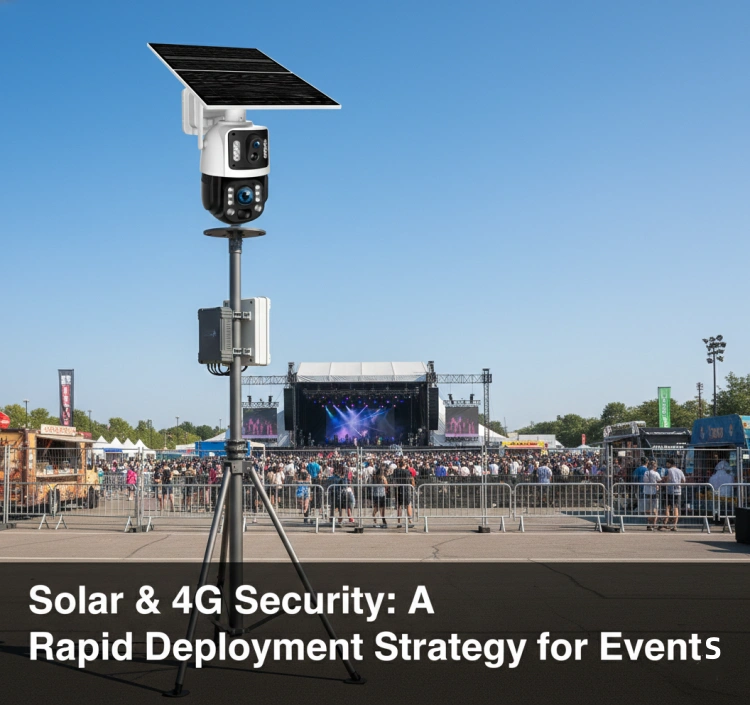
Rapid Deployment Security for Temporary Events: A Solar and 4G Engineering Strategy
Temporary events such as music festivals, marathons, and trade fairs present a unique set of security challenges. Unlike permanent installations, these sites often lack fixed electrical grids and wired internet infrastructure. Security managers face the pressure of securing vast perimeters within hours, only to dismantle the entire system once the event concludes. In my 13 years of engineering solar security systems, I have seen projects fail not because of the camera quality, but due to poor deployment strategies and power mismanagement.
For B2B stakeholders—including event organizers, equipment rental companies, and security contractors—the priority is a “zero-infrastructure” solution. You need a system that functions the moment it is mounted on a pole or tripod. This is why rapid deployment 4G solar cameras have become the industry standard for short-term projects, offering the flexibility to move and reconfigure security zones on the fly.
The core of this technology lies in the integration of high-efficiency solar panels, long-life lithium batteries, and low-power 4G LTE modules. By eliminating the need for trenching and cabling, these systems reduce installation costs by up to 70% while ensuring the site is monitored from day one. Whether you are managing building site security or a high-profile public event, understanding the technical nuances of these systems is critical for operational success.
The Engineering Behind Rapid Deployment Systems
From a production perspective, a rapid deployment camera is more than just a camera with a battery. It requires a sophisticated Battery Management System (BMS) to handle the fluctuating charge cycles inherent in temporary setups. Since event sites might have scaffolding or temporary structures that cast shadows, the BMS must be capable of optimizing “low-light” charging to prevent system downtime. This is particularly vital for BMS technology in solar cameras, which ensures the battery remains healthy even during deep discharge cycles.
Connectivity is the second pillar. In a crowded event with thousands of attendees, local WiFi networks often become saturated and unreliable. Engineers prefer 4G LTE or even 1000 ft long-range wireless cameras for point-to-point transmission. 4G bypasses the local congestion by using dedicated IoT bands, ensuring that the live feed remains accessible to the command center regardless of how many people are using their phones nearby.
Furthermore, the physical design must facilitate “evacuation” or teardown. We design these units with quick-release brackets and modular solar panels. A single technician should be able to unmount and pack a unit in under five minutes. This portability is why many of our clients prefer the S10-4G Ubox Mini Solar PTZ camera, which offers a compact form factor without sacrificing PTZ functionality or image quality.
Technical Comparison: Traditional CCTV vs. Rapid Deployment Solar 4G
To understand the business value, it is essential to compare the traditional approach with modern rapid-deployment engineering. The following table highlights the key differences in resource allocation and performance.
| Feature | Traditional Wired CCTV | Rapid Deployment Solar 4G |
|---|---|---|
| Installation Time | 3-7 Days (Trenching & Cabling) | 15-30 Minutes per Unit |
| Infrastructure Requirements | AC Power & Wired Fiber/Ethernet | None (Off-Grid) |
| Scalability | Difficult (Requires new wiring) | High (Add/Move units instantly) |
| Labor Costs | High (Multiple technicians/electricians) | Low (Single technician) |
| Data Connectivity | Reliable but static | Global 4G LTE / 4G IoT Connectivity |
Core Case Study: Security for a Cross-Country Marathon
Problem: A regional marathon organizer needed to monitor five remote hydration stations and three critical junctions over a 26-mile course. Traditional power was unavailable, and the terrain prevented a standard WiFi mesh setup. They needed a solution that could be set up at 5:00 AM and removed by 5:00 PM the same day.
Solution: We deployed eight long-range solar security cameras equipped with 4G SIM cards. Each unit was mounted on a heavy-duty portable tripod. The engineering team configured the cameras to use PIR (Passive Infrared) motion detection to save power, only triggering high-definition recording and alerts when staff or runners entered the zone. This minimized data usage while ensuring all critical moments were captured.
Result: The event security team maintained 100% visibility throughout the race. One attempted theft of timing equipment at a remote station was thwarted in real-time when the PIR sensor triggered a siren and flash light alarm, alerting a nearby marshal. The entire system was packed into two transport vans within 60 minutes of the race finishing.
Expert Selection Guide: Choosing the Right System for Events
As an engineer, I recommend looking beyond the megapixels. When selecting a system for temporary events, use this checklist to ensure the hardware can withstand the rigors of the field:
- Battery Chemistry: Insist on LiFePO4 (Lithium Iron Phosphate) batteries. They offer better thermal stability and a higher number of charge cycles compared to standard Li-ion, which is crucial for outdoor heat exposure.
- Smart Dual-Light Technology: For night security at events, look for cameras with Smart Dual-Light night vision. This allows the camera to stay in infrared mode to remain discrete, but switch to full-color white light when motion is detected to capture forensic-level detail.
- Weatherproofing: Ensure the housing is at least IP66 rated. Temporary events often involve dust, rain, and wind. The mounting hardware must also be vibration-resistant.
- Remote Management: The software platform should allow for bulk configuration. For example, if you are deploying 50 cameras, you need to be able to sync their motion sensitivity settings simultaneously through a central app or CMS.
- Dual Lens Capability: For large gathering areas, a floodlight dual-lens solar camera provides both a wide-angle overview and a zoomed-in detail view, replacing the need for two separate units.
Troubleshooting Common Deployment Issues
In the field, things don’t always go as planned. Here are the three most common technical issues and how to solve them before they disrupt your event:
- Signal Dropout in High-Density Areas: If the 4G signal is weak due to the crowd, use an external high-gain antenna. We often engineer our 4G construction site cameras with SMA connectors to allow for antenna extensions that can be mounted higher than the camera itself.
- Premature Battery Drain: This is usually caused by excessive “false triggers” from moving flags or trees. Adjust the PIR sensitivity or use AI-human detection to ensure the camera only wakes up for relevant events. You can learn more about this in our guide on how low-power cameras work.
- SD Card Corruption: Temporary deployments involve frequent power-on/power-off cycles. Always use “Endurance” grade SD cards or utilize cloud storage to ensure footage isn’t lost during the physical evacuation of the equipment.
Market Trends: The Shift Toward Intelligence and Autonomy
The market for temporary security is moving away from simple recording toward proactive intelligence. We are seeing a surge in demand for GPS-enabled cameras, which allow event managers to see the exact location of every mobile unit on a digital map. This is particularly useful for large-scale environmental monitoring or wildlife protection projects where cameras might be spread over miles of forest or coastline.
Furthermore, the integration of AI at the edge is reducing data costs. Instead of streaming video to a server for analysis, the camera itself identifies a person or vehicle and only sends the alert. This “edge computing” approach is the future of solar security camera market potential, enabling longer battery life and lower operational costs for B2B providers.
Conclusion: Engineering Success in Temporary Security
For wholesalers and contractors, the commercial value of battery-powered security cameras lies in their versatility. A single fleet of 4G solar cameras can be rented out for a construction project in January, a music festival in June, and a municipal roadwork project in October. The ROI (Return on Investment) is significantly higher than that of fixed wired systems due to the eliminated labor costs and high reuse rate.
By focusing on robust BMS technology, high-gain 4G connectivity, and rapid-mount hardware, you can provide a security solution that is as dynamic as the events you are protecting. If you are looking to upgrade your fleet or start a security rental business, choosing the right battery-powered camera supplier is the first step toward technical and commercial success.
For more technical insights and to explore our range of rapid-deployment solutions, visit our resources on how solar-powered security cameras are revolutionizing the industry or contact our engineering team for a customized B2B consultation.