
How a Smart BMS Doubles Solar Camera Life & Slashes After-Sales Costs
Worried About High After-Sales Costs for Solar Cameras? How the SDL500 BMS System Doubles Battery Life
In the security industry, after-sales service is often the “silent profit killer” for distributors and engineering contractors. If you are a brand owner or an Amazon seller, you know the pain: a customer buys a batch of solar cameras, but six months later, 15% of the units stop working because the batteries no longer hold a charge. This results in costly returns, negative reviews, and a damaged brand reputation.
As an engineer with 13 years of experience in solar security camera design, I have analyzed thousands of failed battery packs. Most failures aren’t caused by the battery cells themselves, but by a subpar Battery Management System (BMS). Our latest SDL500 series addresses this head-on. By integrating an industrial-grade BMS, we have effectively doubled the operational lifespan of our wireless outdoor security cameras.
The Real Reason Your Solar Cameras Fail After One Winter
Most standard solar cameras on the market use basic protection boards that only prevent extreme overcharging or short circuits. However, outdoor environments are brutal. High summer temperatures accelerate chemical aging, while freezing winter temperatures can cause permanent lithium plating if the battery is charged below 0°C.
Without a smart BMS, the battery cells become unbalanced. One cell might reach 4.2V while another is at 3.8V. The system stops charging to protect the high cell, leaving the others undercharged. Over time, the usable capacity of the entire pack drops to nearly zero. This is why many battery-powered security cameras fail just as the warranty expires.
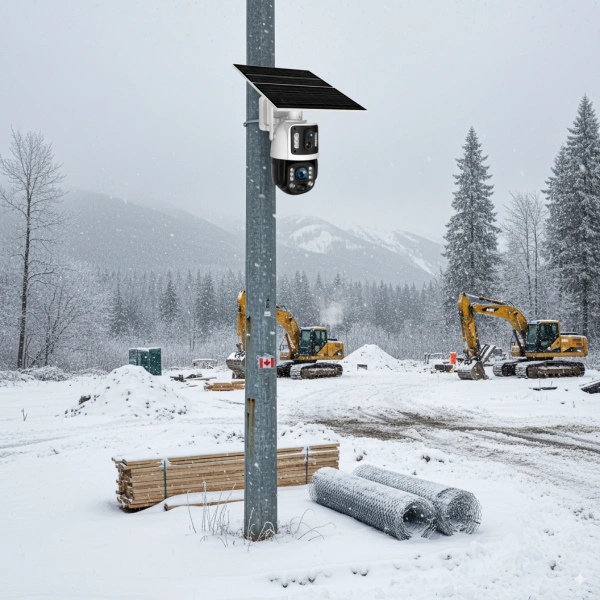
Technical Breakdown: What Makes the SDL500 BMS Different?
The SDL500 BMS system is not just a circuit breaker; it is a smart controller that manages the “State of Health” (SOH) of every cell. It employs a three-layer protection architecture that is typically found in electric vehicle (EV) batteries rather than consumer-grade security cameras.
First, it features high-precision Coulomb counting. Traditional cameras estimate battery levels based on voltage, which is notoriously inaccurate for lithium batteries. Our BMS tracks the actual energy flow, ensuring the camera enters a “deep sleep” mode at exactly 10% SOC (State of Charge) to prevent over-discharge, which is the #1 cause of dead batteries in solar powered security cameras.
Second, the SDL500 includes thermal logic. If the internal temperature drops below freezing, the BMS restricts the charging current to a “trickle” to prevent crystal formation inside the cells. This technology is vital for our clients in regions like Canada and the UK, where winter sun is scarce and temperatures are low.
Comparative Analysis: Standard BMS vs. SDL500 Smart BMS
To help you understand the commercial impact, let’s look at how the SDL500 compares to generic models often found on platforms like Alibaba or from lower-tier factories.
| Feature | Generic Protection Board | UBOXCAM SDL500 Smart BMS | Benefit to You |
|---|---|---|---|
| Capacity Utilization | 70-80% due to imbalance | 95%+ with active balancing | Longer runtime per charge |
| Low-Temp Protection | None (leads to cell damage) | Smart Current Limiting & Cut-off | Survives harsh winters |
| Life Cycles | 300 – 500 cycles | 1000 – 1500 cycles | Doubles the product lifespan |
| Standby Power Loss | 5-10mAh per day | <1mAh per day | Maintains charge during shipping |
| After-Sales Rate | 8% – 12% annually | <1% annually | Protects your profit margins |
Why B2B Buyers Should Prioritize BMS Specifications
If you are a battery powered security camera manufacturer or a wholesaler, your biggest cost isn’t the purchase price; it’s the “Total Cost of Ownership.” Replacing a faulty camera at a remote construction site involves labor costs, shipping fees, and potential contract penalties.
For project installers managing building site security cameras, reliability is everything. A camera that dies in the middle of a project leaves the site vulnerable and the contractor looking unprofessional. By choosing the SDL500 system, you are buying peace of mind. Our data shows that partners who switched to our BMS-equipped models reduced their return rates by 85% within the first year.
Furthermore, the SDL500 is optimized for 4G vs WiFi solar cameras. 4G modules consume significantly more power during transmission. Our BMS handles these high-current peaks without causing voltage drops that might lead to system reboots or offline issues.
Case Study: Remote Farm Monitoring in Switzerland
Problem: A distributor in Switzerland was struggling with high return rates on solar cameras installed on alpine farms. The combination of heavy snow, low temperatures, and high-bandwidth 4G usage caused batteries to fail within four months.
Solution: We provided them with our S10 4G Ubox Mini Solar PTZ Camera equipped with the SDL500 BMS. We also recommended a specific solar panel angle to maximize winter sun exposure.
Result: After two full winters, the failure rate for their “Alpine Pro” line remains under 0.5%. The distributor has since expanded their order to include hunting cameras with GPS, leveraging the same reliable power architecture.
Optimizing Your Solar Camera Selection: A Checklist
- Verify Battery Chemistry: Ensure the factory uses LiFePO4 (for extreme heat) or high-density NCM (for balanced performance) with a dedicated BMS.
- Check “Low Power” Architecture: A good BMS should work in tandem with the SOC (System on Chip) to achieve ultra-low standby currents. Learn more about what is a low power camera.
- Assess Customization Capabilities: Can the manufacturer tune the BMS firmware for your specific climate? We offer this as part of our battery powered security camera supplier services.
- Review Certifications: Ensure the battery packs have UN38.3, MSDS, and IEC62133 certifications for safe international shipping.
Future Trends: The Convergence of BMS and AI
As we look toward 2026, the industry is moving toward “Predictive Maintenance.” The next generation of our SDL series will feature cloud-connected BMS monitoring. This will allow operators of construction site security cameras to see the health of their battery packs remotely and receive alerts before a failure occurs.
This level of data is invaluable for government and municipal projects, where infrastructure must remain operational 24/7. Whether it’s for wildlife protection or flood prevention, the power system is the heartbeat of the device.
The Bottom Line: Quality is the Best Marketing
Lowering your price might get you a first sale, but only quality gets you a second sale. In the competitive world of Amazon and global distribution, after-sales issues are a cancer that eats your profits and your ranking. Investing in a superior BMS is the most cost-effective way to scale your security business.
If you are ready to upgrade your product line and eliminate battery-related headaches, contact our engineering team at UBOXCAM. We specialize in high-performance long range solar security cameras and bespoke ODM solutions for global brands. Let’s build a product that works as hard as you do.
For more technical insights on solar security, check out our analysis on the 2025 Solar Security Camera Market Potential or dive deep into BMS: The Key Technology of Solar Security Cameras.