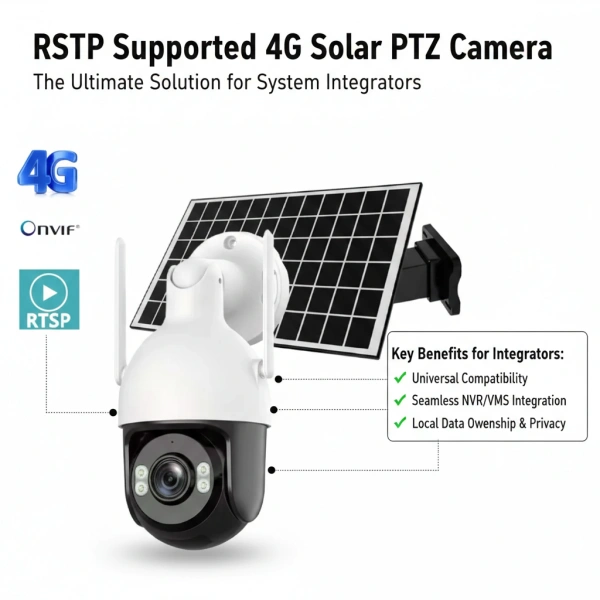
How to solve the “battery drain” issue when using RTSP on solar IP cameras?
How to solve the “battery drain” issue when using RTSP on solar IP cameras?
“Battery drain” is the number one reason manufacturers disable RTSP on solar cameras. In a standard setup, RTSP acts like a “vampire”—it prevents the camera from entering sleep mode, forcing the 4G module and the CPU to remain in a high-power state to listen for pings from your NVR or VMS.
To solve this without your camera dying every night, you need to address the “Energy In vs. Energy Out” equation through a combination of hardware “brute force” and software optimization.
1. The Hardware Solution: Increase the “Energy Bank”
You cannot solve a mathematical power deficit with software alone. If your camera consumes more mA (milliamps) than it harvests, it will fail.
-
Upgrade to 20,000mAh: Standard solar cameras use 5,000mAh batteries, which offer zero “buffer” for the constant heartbeat of an RTSP stream. The RTSP-DM01-4G uses a 20,000mAh industrial battery, providing 4x the stamina to handle the active protocol load.
-
High-Wattage Harvesting: Switch to a 15W Monocrystalline panel. A tiny 5W panel cannot replenish the heavy drain caused by 24/7 4G transmission. You need a panel that can “fast-charge” the battery during limited daylight hours.
2. The Software Solution: H.265 Smart Encoding
The more data your camera has to “push” through the 4G antenna, the more power it consumes.
-
Switch from H.264 to H.265: H.265 (HEVC) compresses video 50% more efficiently. This reduces the workload on the camera’s processor and the transmission time of the 4G module, directly lowering the power draw on the battery.
3. The Integration Strategy: “Pull on Demand” vs. Constant Stream
How you configure your VMS (Blue Iris, Milestone, etc.) determines the battery’s lifespan.
-
Avoid Continuous Recording: Unless you have massive solar arrays, do not record 24/7 to the NVR.
-
Use Dual-Streaming: * Sub-Stream: Set your VMS to pull a low-resolution sub-stream for constant “Heartbeat” monitoring (low power).
-
Main-Stream: Trigger the 4.0MP High-Def stream only when motion is detected or when an operator manually views the feed.
-
4. Advanced Power Logic: MPPT Controllers
Cheap solar cameras use PWM (Pulse Width Modulation) controllers which waste about 20-30% of the solar energy.
-
The Pro Fix: Use a camera with an MPPT (Maximum Power Point Tracking) controller. It optimizes the voltage from the 15W panel to ensure the battery is receiving the maximum possible current, even in low-light or winter conditions.
Summary: Pro-Series vs. Consumer Setup
| Feature | Consumer Solar Camera | RTSP-DM01-4G (The Fix) |
| Battery Capacity | 5,000mAh (Drains in hours) | 20,000mAh (Lasts for days) |
| Solar Input | 3W-5W (Too slow) | 15W (Industrial Recovery) |
| Compression | H.264 (Power hungry) | H.265 (Power efficient) |
| RTSP Status | Often disabled to hide drain | Native & Optimized |
Summary
The “battery drain” issue is solved by moving away from retail “toys” and moving toward industrial-grade hardware. By combining a 20Ah battery buffer with H.265 efficiency, the RTSP-DM01-4G maintains the RTSP connection without falling into a “Deep Discharge” death spiral.
Would you like me to send you a “Power Consumption Guide” that shows exactly how many days of autonomy our 20,000mAh battery provides under different RTSP streaming loads?